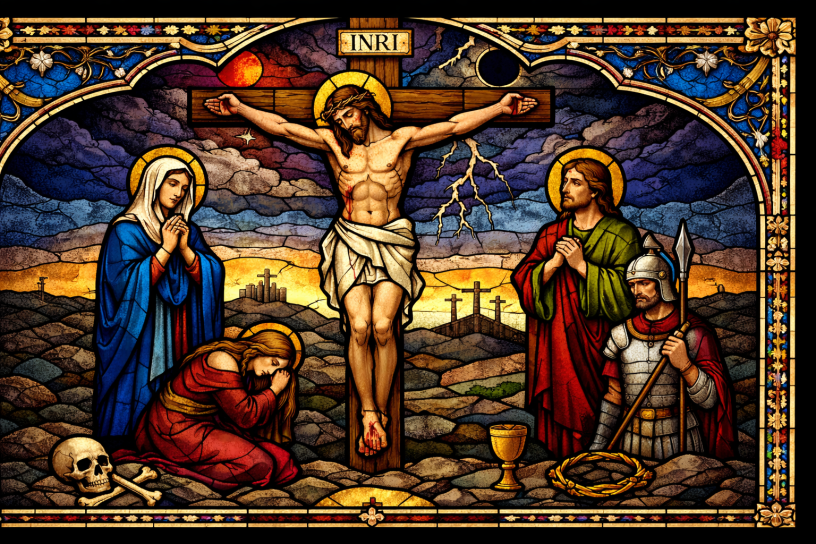
“Now two others also, who were criminals, were being led away to be put to death with Him. And when they came to the place called The Skull, there they crucified Him and the criminals, one on the right and the other on the left. But Jesus was saying, “Father, forgive them; for they do not know what they are doing.” And they cast lots, dividing up His garments among themselves. And the people stood by, looking on. And even the rulers were scoffing at Him, saying, “He saved others; let Him save Himself if this is the Christ of God, His Chosen One.” And the soldiers also mocked Him, coming up to Him, offering Him sour wine, and saying, “If You are the King of the Jews, save Yourself!” Now there was also an inscription above Him, “THIS IS THE KING OF THE JEWS.”” -Luke 23:32-38 LSB
The Scene
Imagine this scene with me. Jesus is being led away from Pilate’s judgment seat with two other condemned criminals. He is being led by a group of Roman soldiers who mock him, through a crowd of frustrated Jews who scorn him, and towards the hill of the skull, where he will hang between Heaven and earth as the living embodiment of the curse of sin.
Jesus is an innocent man. His life had been marked by miracles for the weak, sermons for the lost, and love for the despised. He was betrayed by one of his closest friends, Judas, for the price of a slave. The religious leaders of Judaism hated Jesus without cause. While Jesus stood before Pilate, the Roman governor of Judea, he was found not guilty. This declaration of innocence by Pilate did not stop the Jews from demanding his execution, and his innocence did not stop Pilate from willingly sentencing this innocent man to death by crucifixion.
Jesus walks to his death like a Passover lamb and never opens his mouth to declare the injustice of Judas, Pilate, the Sanhedrin, or the Roman soldiers. Jesus goes to His death willingly, because He truly is the lamb of God who will take away the sins of the world. No one is capable of taking Jesus’ life from Him, but He lays down His own life, as the Good Shepherd who willingly sacrifices Himself for His sheep. This moment is not an accident; it is God’s preordained plan. This march toward death, though despised by Jesus, is the willful expression of Jesus’ unyielding love for God and for all of God’s people. His death is the only satisfactory payment for our sins. There is no other way, so our Savior will take the cup of God’s wrath that we deserve, and He will drink that cup dry; He will drink it to the dregs.
At the end of Jesus’ journey to the place of crucifixion, he was fastened to an old rugged cross. The Almighty now hangs bleeding, suffering, and dying between two other men like a common criminal. His blood stains the cross, He gasps for every breath, and His body writhes in pain, but He is undaunted in His divine task of atonement for the sins of His people. In His resolve, He finally opens His mouth to speak. The Savior’s words are for them, and they are for you; listen to Him. He says, “Father, forgive them; for they do not know what they are doing.
Why do “we” need forgiveness?
As Jesus hung upon that cross, He said, “Forgive them.” His words might be understood as only asking the Father to forgive the Roman soldiers who were happily carrying out their orders to crucify Jesus. Maybe Jesus’ words “forgive them” were merely intended for the Jewish crowd that once celebrated His ministry, but now has viciously cried out to Pilate for His death. Then again, it’s possible that Jesus is simply asking the Father to “forgive” Pilate and the Sanhedrin for their evil part in His death. These are all possible interpretations, but I think there is more intention in Jesus’ words than only His immediate suffering. He intends to be the one man who stands between God and humanity to reconcile us, mediating for us forgiveness through His own personal payment for our debt of sin.
The reason Jesus hung on that cross was not because the Sanhedrin captured him, not because Pilate had authority over him, not because Rome saw him as a threat to their empire, and not because he did anything against the law that would justify the penalty of death. Jesus hung on that cross because that was God’s will. The world was broken by sin, full of evil, deceived by spiritual wickedness, and that cross was God’s chosen place for sacrifice. Jesus’ cross had become an altar, and He was the lamb of God. Jesus hung on that cross because we had become helpless sinners who had no hope, no future, and no understanding of the dangerous wrath of God that we had been storing up against ourselves in the day of judgment. Jesus hung on that cross to stand in our place and receive the earned wrath of God for sinners.
“… the wages of sin is death…” -Romans 6:23
“We” need God’s forgiveness because we are sinners, and the law’s penalty for sin is death. It’s possible that we don’t understand this consequence. We are aware that death inevitably comes for us all in this life, but the “wages”, the earned reward for breaking God’s law, is to be put to death by God the Judge, body and soul in Hell. We all deserve death because we are all sinners, and that is why we all need God’s forgiveness. We need this forgiveness to live. We need God’s forgiveness to survive death and to be with Him.
Why does Jesus’ sacrifice make forgiveness possible? Why not simply say, “I forgive you”?
God’s justice and forgiveness have always been connected with sacrifice, think with me about Moses on the side of Mt Sinai, and God walking by Moses and telling Moses who He really is.
“… Yahweh descended in the cloud and stood there with (Moses) him, and He (Moses) called upon the name of Yahweh. Then Yahweh passed by in front of him and called out, “Yahweh, Yahweh God, compassionate and gracious, slow to anger, and abounding in lovingkindness and truth; who keeps lovingkindness for thousands, who forgives iniquity, transgression, and sin; yet He will by no means leave the guilty unpunished, visiting the iniquity of fathers on the children and on the grandchildren to the third and fourth generations.”” -Exodus 34:4-7
Did you hear what God said? God forgives, but will not leave the guilty unpunished. What does this mean? To some, it sounds like God is contradicting Himself, saying, “I forgive, but I don’t really forgive.” How should we make sense of this riddle? What does God mean by saying He forgives but will by no means leave the guilty unpunished?
It means at least two things: God will not forgive everyone, and He will not forgive arbitrarily. God is the perfect Judge, and He will not leave the guilty unpunished, because that is what corrupt judges do. Imagine two guilty thieves stand before the same judge. One thief is punished for his crime. The second thief is not punished. In fact, that second thief is actually given wealth beyond his wildest imagination. Does that sound like a good judge? Is this how God judges the world? Does God decide to punish some, but not all, for their law-breaking? He says, He doesn’t forgive like that. God said, “He will by no means leave the guilty unpunished”.
Let’s restate this problem again for the sake of clarity. First, God is a perfect lawgiver and judge who will never allow sin to go unpunished. Second, besides Jesus Christ, all people are guilty of sin. Third, God promised He would never leave the guilty unpunished. So then, how will God forgive people if He refuses to leave the guilty unpunished?
Jesus is the answer. Jesus is God become man, and the perfect substitute, the perfect sacrifice for human sinners. Because Jesus was sinlessly innocent and chose to die in the place of sinners, God is perfectly Just to forgive guilty sinners. God is perfectly Just to forgive guilty sinners because God punished them in Christ. Jesus received their punishment for their sin. It is Jesus’ sacrifice that makes it possible for God to forgive sinners without ever leaving the guilty unpunished.
“All of us like sheep have gone astray, Each of us has turned to his own way; But Yahweh has caused the iniquity of us all To fall on Him. He was oppressed, and He was afflicted, Yet He did not open His mouth; Like a lamb that is led to slaughter, And like a sheep that is silent before its shearers, So He did not open His mouth. By oppression and judgment, He was taken away; And as for His generation, who considered That He was cut off out of the land of the living, That for the transgression of my people, striking was due to Him? So His grave was assigned with wicked men, Yet He was with a rich man in His death, Because He had done no violence, Nor was there any deceit in His mouth. But Yahweh was pleased To crush Him, putting Him to grief; If You would place His soul as a guilt offering, He will see His seed, He will prolong His days, And the good pleasure of Yahweh will succeed in His hand.” Isaiah 53:6-10
How do we receive forgiveness?
Let’s make sure we are all on the same page. All people are guilty sinners, and God promised to punish all guilty sinners with death. Yet, God made a way of salvation and forgiveness for sinners through the sacrifice of Jesus Christ, who willingly received death in the place of sinners. Through faith in Christ, we receive the forgiveness that Jesus offers in the Gospel. We are Christ’s and Christ is ours by faith.
What must we do to be forgiven by God? How do we receive forgiveness through Jesus’ sacrifice? Do you know the story about the man we call the Philippians jailer? The Apostle Paul was traveling throughout the region of the Mediterranean, preaching the gospel of Christ and establishing churches. In the process of fulfilling his apostolic calling, He came to the Roman city of Philippi. In Philippi, there was a demon-possessed girl that Jesus healed through Paul, and as a reward for the miracle, the city hated him and put him into prison after a severe beating. During the night, Paul and his partner Silas began to sing songs of praise to God, and God caused an earthquake that threw open the prison doors, and every prisoner’s shackles were also unloosed. The Philippian jailer, the guard, awoke and thought the prisoners had escaped and was ready to take his own life, until Paul stopped him. This was a miracle not only because God released his missionaries from their prison, but also because God kept all the prisoners from escaping. In ancient Roman law, a prison guard who lost his prisoner could be killed as a result. So, when the Philippian jailer realized his life was not in danger, and Paul’s God was responsible for it all, he was ready to convert.
“And he (Philippian jailer) called for lights and rushed in, and trembling with fear he fell down before Paul and Silas, and after he brought them out, he said, “Sirs, what must I do to be saved?” And they said, “Believe in the Lord Jesus, and you will be saved, you and your house.” And they spoke the word of the Lord to him together with all who were in his household. And he took them that very hour of the night and washed their wounds, and immediately he was baptized, he and all his household. And he brought them into his house and set food before them, and rejoiced greatly with his whole household, because he had believed in God.” -Acts 16:29-34
We receive the benefits of Christ’s sacrifice through faith alone. We are not saved by faith in Christ plus anything. We are not recipients of saving Grace by faith plus our actions. We are saved by “Grace … through faith and that not of ourselves it (salvation) is the gift of God, not of works, lest anyone boasts.” We receive God’s forgiveness through Christ’s sacrifice by faith.
Do I Have Enough Faith?
Our receiving forgiveness is not based upon how much faith we have. Did Paul try measuring the Philippian jailer’s faith? No. Your faith may be weak or strong today, but your forgiveness is not dependent upon your amount of faith. Remember Jesus’ description of the early Apostles’ faith, “ye of little faith”? Jesus was not withholding himself from Peter and the other apostles until their faith increased. Therefore Jesus does not withhold himself from believers, no matter how small their faith may be. Do you believe Jesus is the Savior? Do you believe Jesus is your Savior? Was His cross for your salvation? Was his life offered to save yours? Do you believe? It is enough. You may have a thousand questions, and there’s likely so much that you do not yet understand, but take courage because Jesus will take your little faith and multiply it like loaves and fishes. You may be small in faith today, but God will surely increase your faith. You are not forgiven because you have enough faith. You are forgiven by Christ’s sacrifice through faith, and that is enough. Your faith in Christ is enough.
How much will God really forgive?
God forgives as far as the east is from the west. Listen to the Holy Spirit’s words through the pen of King David as he expounded upon God’s self-revelation to Moses.
“He has not dealt with us according to our sins, And He has not rewarded us according to our iniquities. For as high as the heavens are above the earth, So great is His lovingkindness toward those who fear Him. As far as the east is from the west, So far has He removed our transgressions from us. As a father has compassion on his children, So Yahweh has compassion on those who fear Him.” -Psalm 103:10-13
God’s forgiveness is as high as the heavens above the earth – infinite
God’s forgiveness is as far as the east is from the west – infinite
God’s forgiveness is as a father’s compassion – infinite
God’s forgiveness is final. He knows what you’ve done.
The better question is: How grateful are you for the absolute forgiveness of God?
From Jesus’ first words on the cross, “Father, forgive them,” to His last words, He was thinking of you. He was laying down His life for yours.
“Therefore when Jesus had received the sour wine, He said, “It is finished!” And bowing His head, He gave up His spirit.” -John 19:30
 Aaron Irlbacher
We can’t possibly fathom this. It’s too big for us. And yet it is for us, for Him. This — all of this — is a gift we are incapable of recompensing. Even in our attempts to obey, follow, and seek Him, we find that it is still us receiving gifts all the more. I am filled with weeping joy. I’m terrified to fail Him. I, daily, fail. But I love Him… because He first loved me.
“Now this gospel truth of old, shall not kneel and shall not faint
And by His blood and in His name, in His freedom I am free
For the love of Jesus Christ who has resurrected me”
LikeLike